TEACHING
Courses with Materials

Course: Research Methodology
Level: Postgraduate
Description:
This course (NMEC595 - Research Methodology and Statistics) introduces students to the fundamentals of scientific research, covering the entire research process from problem identification and hypothesis formulation to research design and execution. It emphasizes practical statistical tools including probability distributions, hypothesis testing, ANOVA, regression analysis, and sampling techniques necessary for data collection, analysis, and drawing meaningful conclusions from research data. The course also addresses critical aspects such as measurement scales, data presentation, report preparation, and ethical considerations like plagiarism in research.
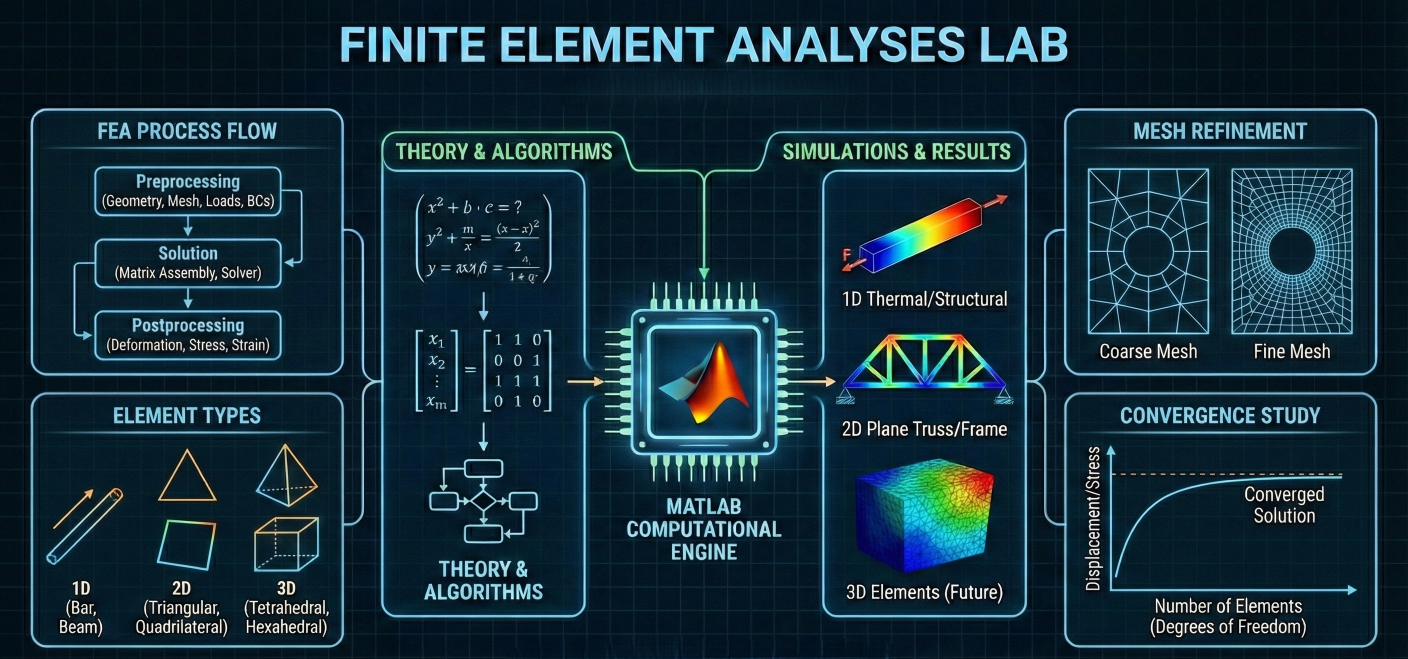
Course: Finite Element Analyses Lab
Level: Postgraduate
Description:
This lab course (NMEC535 - Finite Element Analyses Lab) provides hands-on training in developing algorithms and MATLAB codes for classical Finite Element Analysis of structural systems. Students learn to program various element types including linear and quadratic bar elements, plane trusses, plane frames, and Euler-Bernoulli beams for analyzing 1D, 2D, and 3D structures under static and dynamic loading conditions. The course emphasizes mesh convergence studies, error analysis, and culminates in a mini-project applying FEA to real-life structural problems.

Course: Introduction to MATLAB and SIMULINK
Level: Undergraduate
Description:
This course introduces students to MATLAB programming and Simulink modeling.
It covers fundamental numerical methods, system simulation, and visualization.
Students learn practical applications through engineering case studies.

Course: Mechanics for Engineers
Level: Undergraduate
Description:
Mechanics for Engineers (NMEE101) introduces students to the principles of statics and dynamics, building a strong analytical foundation to tackle real-life engineering challenges. The course emphasizes solving equilibrium problems, analyzing forces and moments in structures, and understanding kinematics and kinetics of particles and rigid bodies. By the end, students will confidently apply mechanics concepts in a structured and logical manner to practical engineering problems.
Workshops with Materials
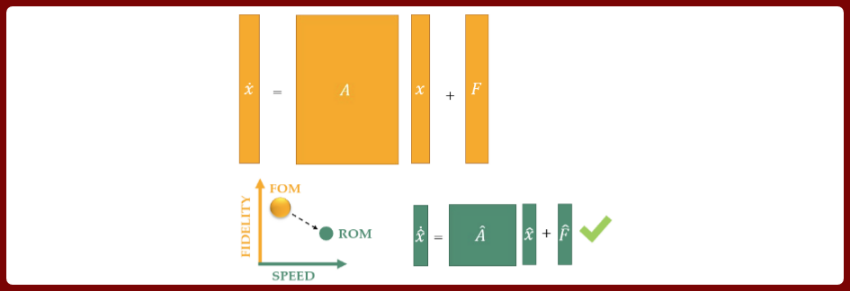 Workshop: Dive into Reduced Order Modeling with pylibROM – April 2024
Description: Reduced-order modeling (ROM) is a computational strategy for approximating high-fidelity numerical models with significantly reduced computational cost. Instead of solving large-scale systems—often with millions of unknowns—ROM techniques construct low-dimensional surrogates that retain the dominant physics of the system, enabling efficient and repeated evaluations. In this workshop I demonstrate the use of popular open-source software called pylibrom, which was developed at the Lawrence Livermore National Lab, for performing model reduction of Large-scale FEA models.
 Workshop: Principal Component analysis
Description: PCA reduces high-dimensional data into uncorrelated components that capture most variance, simplifying analysis and visualization. It is widely used in areas like image compression, genomics/population genetics, microbiome studies, atmospheric science, finance risk factors, feature preprocessing for ML, noise reduction, and visualization of clusters in 2D. This GitHub repo offers a comprehensive PCA introduction with intuition and practical examples for real datasets.
All Teaching Experience
Indian Institute of Technology (Indian School of Mines) Dhanbad
| Course | Role | Level | Year |
|---|---|---|---|
| Research Methodology | Instructor | PG | 2026 |
| Finite Element Analyses Lab | Instructor | PG | 2026 |
| Introduction to MATLAB and SIMULINK | Instructor | UG | 2025 |
| Mechanics for Engineers | Instructor | UG | 2025 |
Texas A&M University
| Course | Role | Level | Year |
|---|---|---|---|
| Workshop: Principal Component Analysis (PCA) | Instructor | UG/PG | 2025 |
| Workshop: Dive into Reduced Order Modeling with pylibROM | Instructor | UG/PG | 2024 |
| Physics-based and Data-Driven Reduced-Order Modeling for Engineering Systems | Guest Lecturer | PG | 2023 |
Pennsylvania State University
| Course | Role | Level | Year |
|---|---|---|---|
| Statics and Strength of Materials | TA | UG | 2020–2021 |
| Dynamics | TA/Instructor | UG | 2015–2020 |
| Experimental Determination of Mechanical Response of Materials | TA | UG | 2014–2015 |
.