About Me
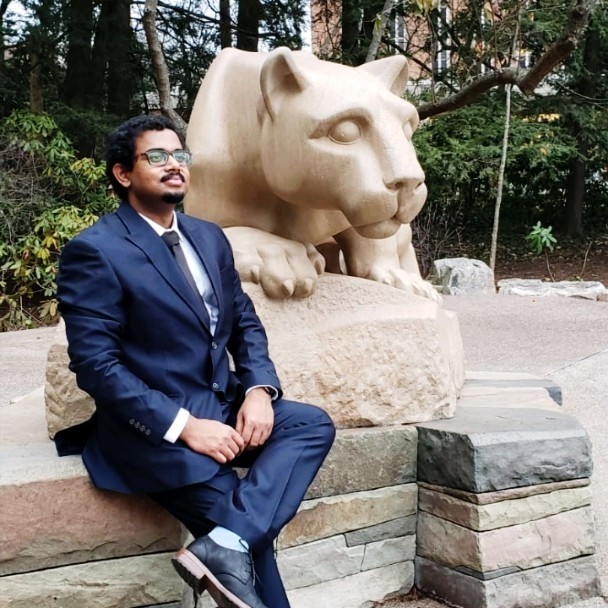
I am Dr. Suparno Bhattacharyya, Assistant Professor in the Department of Mechanical Engineering at IIT (ISM) Dhanbad. I hold a B.E. in Mechanical Engineering from Jadavpur University and an M.Tech. in Mechanical Engineering (Solid Mechanics) from IIT Kanpur, followed by a Ph.D. in Engineering Science and Mechanics from The Pennsylvania State University. Prior to my current appointment, I expanded my research experience as a Postdoctoral Scholar at Clemson University and an Assistant Research Scientist at the Digital Twin Lab at Texas A&M University.
My research centers on computational solid mechanics and data-driven modeling, with recent work on hyper-reduced order models for digital twin applications. Previous projects include vibro-impact modeling, topology optimization of lattice structures, and reduced-order strategies for systems under non-smooth loading. My master’s research focused on experimental characterization of structural damping in metals. More broadly, I work on reduced-order modeling, finite element analysis, computational mechanics, and nonlinear dynamics, supported by programming expertise in MATLAB, Mathematica, and Python.






About D-cubed Lab
At the D-cubed Lab, we investigate and develop efficient modeling techniques for the simulation and design of complex engineering systems. Our research integrates computational mechanics, topology optimization, and data-driven modeling, with an emphasis on capturing mechanical and dynamical behavior across scales and applications.
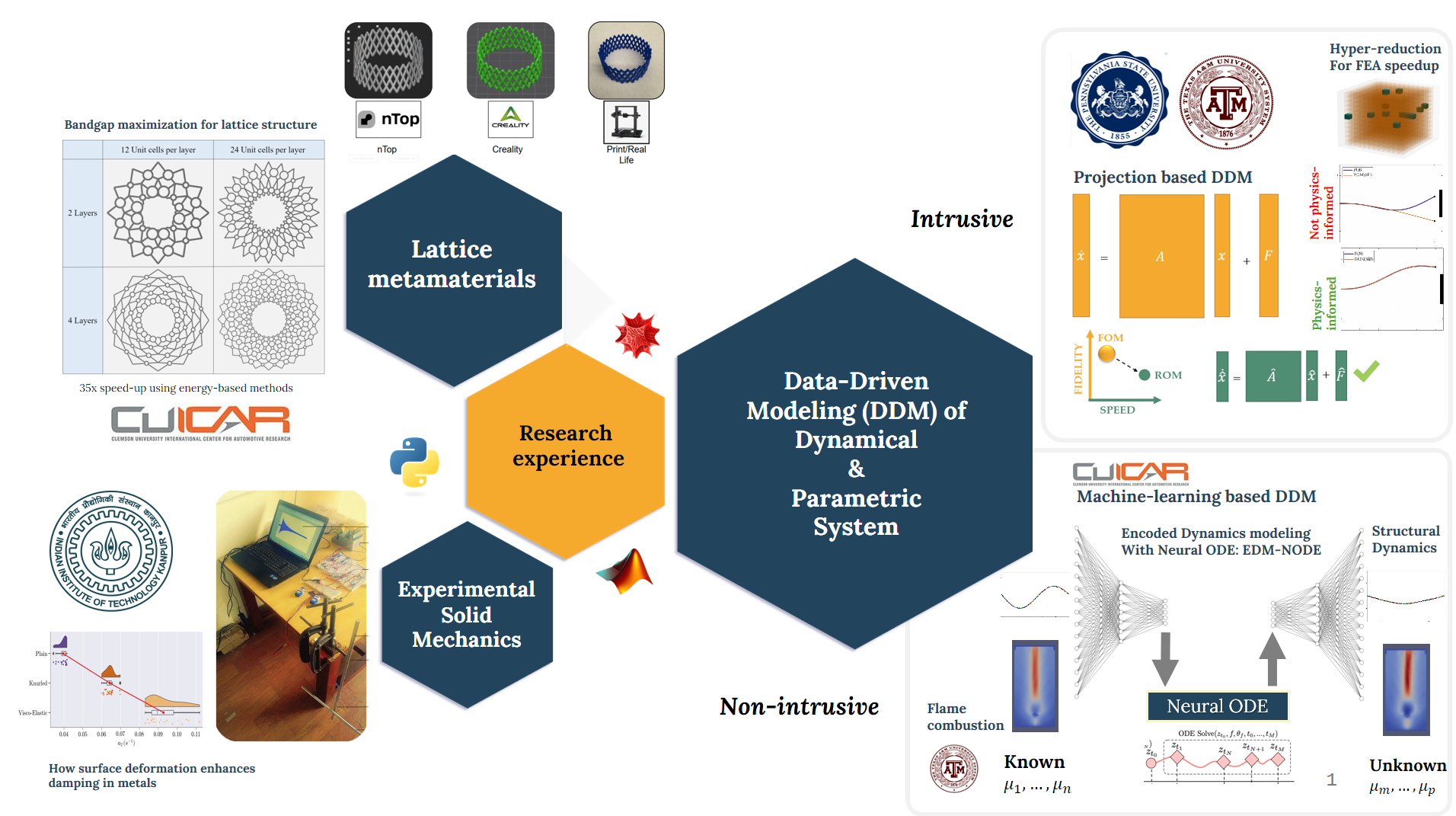
A core theme of our work is the development of intrusive and nonintrusive data-driven methods that retain physical accuracy while enabling significant computational speed-ups. These tools are critical for simulating nonlinear, multiphysics phenomena efficiently—whether in structural dynamics, materials design, or energy systems.
Our contributions span:
• Data-driven ROMs for systems with discontinuities and nonlinearities
• Energy-based closure strategies for improved accuracy in low-dimensional models
• Topology optimization frameworks for periodic and lattice structures with tailored dynamic properties
• Integration of neural ODEs and machine learning into physics-based modeling pipelines
As a natural extension, we are increasingly applying these methods to support digital twin technologies, where real-time simulation and decision-making are essential. By enabling rapid yet accurate predictions in domains such as neutron transport, combustion, and manufacturing, our models help make digital twins a practical tool for engineering insight and control.
Our long-term goal is to push the limits of simulation-driven design, combining physics, computation, and data to tackle emerging challenges in modern engineering.