Hyper-reduction Techniques for Efficient Simulation of Large-Scale Engineering Systems
Abstract
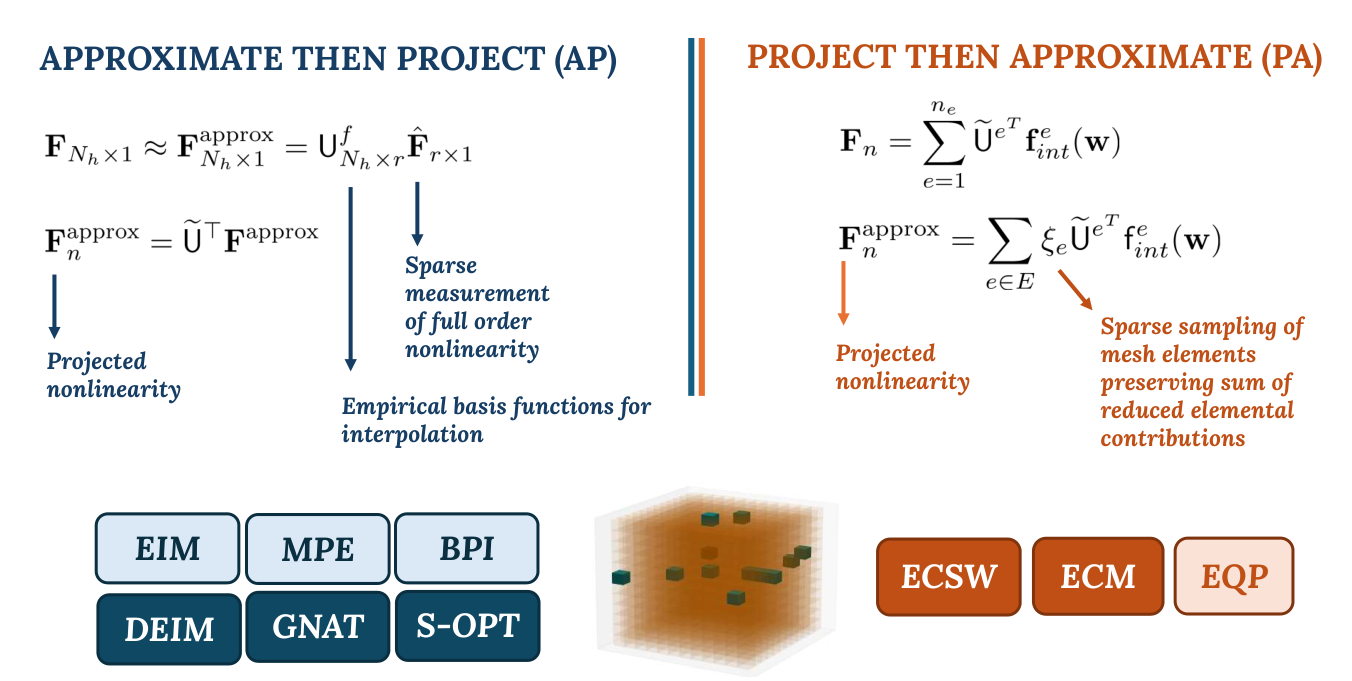
Reduced-order models (ROMs) offer compact representations of complex engineering systems governed by partial differential equations or high-dimensional ordinary differential equations enabling efficient simulations of otherwise computationally intensive problems. These models are typically constructed by projecting the high-dimensional governing equations onto reduced subspaces derived using techniques such as Singular Value Decomposition (SVD) or Proper Orthogonal Decomposition (POD). However, conventional ROMs struggle with nonlinear systems due to the high computational cost of repeatedly accessing high-dimensional solution spaces for nonlinear term evaluations. Hyper-reduction methods address this challenge by efficiently approximating nonlinear term evaluations, significantly improving ROM performance. They are also essential for solving large parametric linear problems that lack an efficient parameter-affine decomposition. This paper provides a comprehensive overview of hyper-reduction algorithms, emphasizing both their theoretical foundations and practical implementations in academic research and industry. With the rapid advancement of data-driven methods, reduced-order modeling has become indispensable for analyzing and simulating large-scale systems, including fluid dynamics, thermal processes, and structural mechanics. As the demand for efficient computational tools in science and engineering continues to grow, a detailed discussion of hyper-reduction techniques is both timely and valuable. The paper explores state-of-the-art hyper-reduction techniques, including discrete empirical interpolation methods (DEIM), energy-conserving sampling and weighting (ECSW), and emerging machine learning-based approaches. A nonlinear parametric heat conduction example is presented to illustrate the implementation of these methods. The analysis evaluates their strengths and weaknesses using standard metrics, providing insights into their practical utility. Finally, the paper concludes by discussing future research directions and potential applications of hyper-reduction, including its integration with real-time simulations and digital twin systems.